EDUSIP

Electrical, electronics and teachers notes, model question question paper, blue print, eBooks, PDFs, programming code, previews year question exam papers, stories, student project ideas, short notes and more

Responsive Ads Here
Showing posts with label Electronics. Show all posts

Monday, July 17, 2017

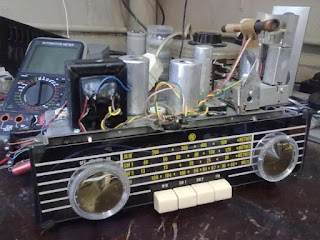
Who really invented radio?


Who really invented radio?


Who really invented radio?


The history of radio technology is plagued by controversy over the question of who actually
invented the thing. The answer most often given is Italian inventor Guglielmo Marconi, but
many others made important discoveries that give them good claim to the title. Here’s a rundown on the contenders for the title of The Father of Radio:

✓ Marconi: He was the first person to demonstrate radio successfully and exploit it commercially.
In 1901, Marconi sent a message via radio across the Atlantic from England to Canada, though the message was faint, consisted of nothing but the letter S, and reception of the message wasn’t independently confirmed. Nevertheless, Marconi’s accomplishment was astonishing, and he
made many important contributions to the technology and business of radio
.
✓ Tesla: In 1943, the U.S. Supreme Court ruled that many of Marconi’s important radio patents were invalid because Nikola Tesla had already described the devices covered by Marconi’s patents. Tesla was a brilliant engineer who is best known for being the champion of alternating current over direct current for power distribution. He publicly demonstrated wireless communication devices as early as 1893. Tesla believed that wireless technology would be used not only for communication, but for power distribution as well.

✓ Lodge: In England, Sir Oliver Lodge was building wireless telegraph systems in the mid-1890s.

✓ Popov: In Russia, Alexander Stepanovich Popov was demonstrating wireless telegraph transmissions around the same time as Lodge.

✓ Bose: In India, Sir Jagadish Chandra Bose was also demonstrating wireless telegraph transmissions in the early 1890s. Whether these demonstrations occurred before, after, or at the same time as other demonstrations by Lodge, Popov, and others is under dispute.

✓ Many others: The list of names of others who did important research and made important  iscoveries in the last decades of the nineteenth century is long: Heinrich Hertz, Edouard Branly, Roberto de Moura, Ernest Rutherford, Ferdinand Braun, Julio Baviera, and Reginald Fessenden are just a few of the many individuals who made important contributions. So it seems that no one person has a clear-cut claim to being the first to invent radio. Work was being done all around the world and discoveries were being made it seems every day. It may be that the best answer is that no one
“invented” radio. Radio is a natural phenomenon. It was discovered, not invented. What was invented were ways to exploit the phenomenon of radio by building devices that could generate radio waves and modulate them to add information, as well as devices that could receive radio waves and extract theinformation that was added.

Understanding Radio Waves


Understanding Radio Waves


Understanding Radio Waves


Most people think of radio as wireless broadcast of sound, most often music and speech. But the term radio is actually much broader than that; the broadcast of sound is actually just one application of the extremely useful electrical phenomenon that is called radio. Radio takes advantage of one of the most interesting of all electrical phenomena: electromagnetic radiation (often abbreviated EMR), which is a type of energy that travels in waves at the speed of light. EMR travels freely through the air and even in the vacuum of space. EMR waves can oscillate at any imaginable frequency. The rate of the oscillation is measured in cycles per second, also known as hertz (abbreviated Hz). The term hertz here does not refer to the car rental company. Instead, it honors the great German physicist Heinrich Hertz, who was the first person to build a device that could create and detect radio waves. Radio is simply a specific range of frequencies of EMR waves. The low end of this range is just a few cycles per second, and the upper end is about 300 billion cycles per second (also known as gigahertz, abbreviated GHz.) That’s a pretty big range, but EMR waves with much higher frequencies exist as well, and are in fact commonplace. EMR waves with frequencies higher than radio waves go by various names, including infrared, ultraviolet, X-rays, gamma rays, and — most importantly — visible light. That’s right; what we call light is exactly the same thing as what we call radio, but at higher frequencies. The frequency of visible light is measured in billions of hertz, also called terahertz and abbreviated THz. The low end of visible light (red) is around 405THz and the upper end (violet) is around 790 THz

Wednesday, May 31, 2017

What Is Electricity?

What Is Electricity?


Before you can understand even the simplest concepts of electronics, you
must first understand what electricity is. After all, the whole purpose of electronics
is to get electricity to do useful and interesting things.
The concept of electricity is both familiar and mysterious. We all know what
electricity is, or at least have a rough idea, based on practical experience. In
particular, consider these points:

✦ We are very familiar with the electricity that flows through wires like
water flows through a pipe. That electricity comes from power plants
that burn coal, catch the wind, or harness nuclear reactions. It travels
from the power plants to our houses in big cables hung high in the air
or buried in the ground. Once it gets to our houses, it travels through
wires through the walls until it gets to electrical outlets. From there, we
plug in power cords to get the electricity into the electrical devices we
depend on every day, such as ovens and toasters and vacuum cleaners.

✦ We know, because the electric company bills us for it every month, that
electricity isn’t free. If we don’t pay the bill, the electric company turns
off our electricity. Thus, we know that electricity is valuable.

✦ We know that electricity can be stored in batteries, which contain a limited
amount of electricity that can be used up. When the batteries die,
all their electricity is gone.

✦ We know that some kinds of batteries, like the ones in our cellphones,
are rechargeable, which means that when they’ve been drained of all
their electricity, more electricity can be put back into them by plugging
them into a charger, which transfers electricity from an electrical outlet
into the battery. Rechargeable batteries can be filled and drained over
and over again, but eventually they lose their ability to be recharged —
and you have to replace them with new batteries.

✦ We also know that electricity is the stuff that makes lightning strike in a
thunderstorm. In grade school, we were taught that Ben Franklin discovered
this by conducting an experiment involving a kite and a key, which
we should not attempt to repeat at home.

✦ We know that electricity can be measured in volts. Household electricity
is 120 volts (abbreviated 120 V). Flashlight batteries are 1.5 volts. Car
batteries are 12 volts.

✦ We also know that electricity can be measured in watts. Traditional
incandescent light bulbs are typically 60, 75, or 100 watts (abbreviated
100 W). Modern compact fluorescent lights (CFLs) have somewhat
smaller wattage ratings. Microwave ovens and hair dryers are 1,000 or
1,200 watts. The more watts, the brighter the light or the faster your
pizza reheats and your hair dries.

✦ We also may know that there’s a third way to measure electricity, called
amps. A typical household electrical outlet is 15 amps (abbreviated 15 A).

✦ The truth is, most of us don’t really know the difference between volts,
watts, and amps. (Don’t worry; by the time you finish Chapter 2 of this
minibook, you will!)

✦ We know that there’s a special kind of electricity called static electricity
that just sort of hangs around in the air, but that can be transferred to
us by dragging our feet on a carpet, rubbing a balloon against our hairy
arms, or forgetting to put an antistatic sheet in the dryer.

✦ And finally, we know that electricity can be very dangerous. In fact, dangerous
enough that for almost 100 years electricity was used to administer
the death penalty. Every year, hundreds of people die in the United
States from accidental electrocutions.

But Really, What Is Electricity?


✦ Electric charge refers to a fundamental property of matter that even
physicists as smart as Stephen Hawking don’t totally understand. Suffice
it to say that two of the tiny particles that make up atoms — protons
and electrons — are the bearers of electric charge. There are two types
of charge: positive and negative. Protons have positive charge, electrons
have negative charge.

Electric charge is one of the basic forces of nature that hold the universe
together. Positive and negative charges are irresistibly attracted to each
other. Thus, the attraction of negatively-charged electrons to positivelycharged
protons hold atoms together.

If an atom has the same number of protons as it has electrons, the positive
charge of the protons balances out the negative charge of the electrons,
and the atom itself has no overall charge.

However, if an atom loses one of its electrons, the atom will have an
extra proton, which gives the atom a net positive charge. When an atom
has a net positive charge, it goes looking for an electron to restore its
balanced charge.

Similarly, if an atom somehow picks up an extra electron, the atom has a
net negative charge. When this happens, the atom goes looking for a way
to get rid of the extra electron to once again restore balance.
Okay, technically atoms don’t really go “looking” for anything. They
don’t have eyes, and they don’t have minds that are troubled when
they’re short an electron or have a few too many. However, the natural
attraction of negative to positive charges causes atoms that are short an
electron to be attracted to atoms that are long an electron. When they
find each other, something almost magic happens . . . The atom with the
extra electron gives its electron to the atom that’s missing an electron.
Thus, the charge represented by the electron moves from one atom to
another, which brings us to the second important concept . . .

✦ Electric current refers to the flow of the electric charge carried by electrons
as they jump from atom to atom. Electric current is a very familiar
concept: When you turn on a light switch, electric current flows from
the switch through the wire to the light, and the room is instantly
illuminated.

Electric current flows more easily in some types of atoms than in others.
Atoms that let current flow easily are called conductors, whereas atoms
that don’t let current flow easily are called insulators.
Electrical wires are made of both conductors and insulators, as illustrated
in Figure 1-1. Inside the wire is a conductor, such as copper or
aluminum. The conductor provides a channel for the electric current to
flow through. Surrounding the conductor is an outer layer of insulator,
such as plastic or rubber.


An electric wire consists of a conductor surrounded by an insulator.

The insulator serves two purposes. First, it prevents you from touching
the wire when current is flowing, thus preventing you from being the
recipient of a nasty shock. But just as importantly, the insulator prevents
the conductor inside the wire from touching the conductor inside
a nearby wire. If the conductors were allowed to touch, the result would
be a short circuit, which brings us to the third important concept . . .

✦ An electric circuit is a closed loop made of conductors and other electrical
elements through which electric current can flow. For example,
Figure 1-2 shows a very simple electrical circuit that consists of three
elements: a battery, a lamp, and an electrical wire that connects the two.
The circuit shown in Figure 1-2 is, as I already said, very simple. Circuits
can get much more complex, consisting of dozens, hundreds, or even
thousands or millions of separate components, all connected with conductors
in precisely orchestrated ways so that each component can do
its bit to contribute to the overall purpose of the circuit. But all circuits
must obey the basic principle of a closed loop.


All circuits must create a closed loop that provides a complete path
from the source of voltage (in this case, the battery) through the various
components that make up the circuit (in this case, the lamp) and back to
the source (again, the battery).